Today’s banking customers expect instant, seamless service whether they are using a mobile app, visiting a branch, walking up to a self-service kiosk, or calling a contact center. They want to check balances, make payments, open accounts, and resolve issues without friction or delay.
Yet many large banks remain constrained by legacy core systems that operate in silos, unable to share data or trigger actions across channels in real time.
This disconnect between customer expectations and technical reality creates slow service, inconsistent experiences, and missed revenue opportunities.
The role of APIs in digital banking is to solve this problem. APIs, or Application Programming Interfaces, act as secure digital connectors that link core banking systems with modern customer channels and third-party platforms.
They enable automation, real-time data exchange, and seamless orchestration across the entire banking enterprise.
For banks managing complex branch networks, multiple digital touchpoints, and growing fintech partnerships, APIs can transform fragmented systems into agile, scalable digital banking services.
According to McKinsey, banks that adopt API-led and modular architectures can reduce time-to-market for new digital products by up to 50% while significantly improving integration flexibility.
This is the starting point for any serious digital banking customer journey modernization effort.
What APIs Mean in the Context of Digital Banking
In the context of digital banking APIs, an API is a set of protocols and tools that allows different software applications to communicate with each other.
Think of it as a secure messenger that takes a request from one system, such as a mobile banking app, delivers it to another system, such as a core banking platform, and returns the response in real time.
APIs abstract the underlying complexity of legacy systems. A customer checking their balance on a smartphone does not need to know that the data resides on a mainframe built decades ago.
The API handles that translation invisibly.
Banking system integration through APIs enables core banking engines, customer relationship management platforms, fraud detection tools, and digital channels to function as a single, unified ecosystem. This is the technical foundation for modern digital banking transformation.
Why APIs Are Critical to Modern Digital Banking
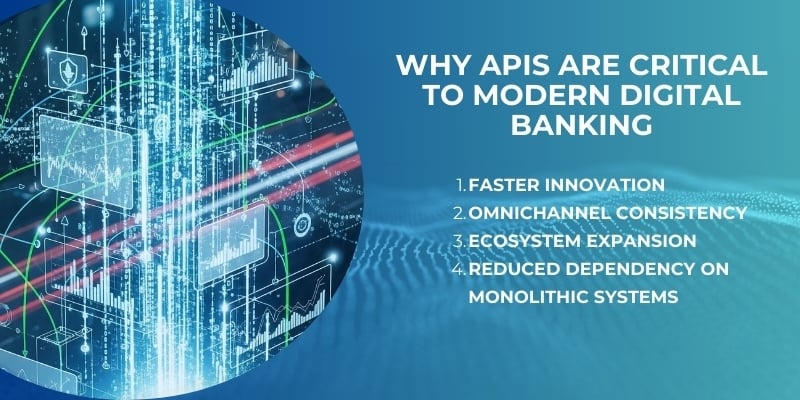
APIs are not just a technical convenience. They are a strategic essential. The role of APIs in digital banking has shifted from optional to foundational because they directly enable four critical business capabilities.
- First, faster innovation. When services are exposed via APIs, developers can build new features quickly without rewriting core systems.
- Second, omnichannel consistency. APIs ensure that a customer receives the same information and service quality whether they are on a web browser, a mobile device, or at a branch counter.
- Third, ecosystem expansion. APIs allow banks to securely partner with fintechs, embed their services into non-banking platforms, and participate in open banking networks.
- Fourth, reduced dependency on monolithic systems. Instead of large, risky core replacements, banks can incrementally modernize by wrapping legacy systems with API layers. The scale of this shift is significant.
Accenture reports that 91 percent of banks see APIs as critical to executing their digital transformation and ecosystem strategies. API-driven banking is now the standard for competitive financial institutions.
How APIs Streamline Core Banking Operations
At the heart of every bank lies its core processing system, often a legacy platform built for batch processing and static product definitions. These systems were never designed for real-time, always-on digital engagement.
Core banking APIs solve this by creating a modern interface layer that sits on top of legacy infrastructure. This banking middleware translates digital requests from modern apps into commands the core system understands and then returns the response instantly.
Account inquiries, fund transfers, loan applications, and interest calculations can all be exposed as secure, reusable API calls.
This approach streamlines operations by automating manual workflows, reducing the need for screen scraping or brittle integrations, and enabling banks to extend the life of their core investments while still delivering modern experiences.
A strategic approach to bank branch transformation relies heavily on this API-enabled connectivity between old and new.
APIs Powering Omnichannel Banking Experiences
Customers do not think in channels. They think in journeys. A customer might research a loan on their mobile phone, complete the application on a laptop, and then visit a branch to finalize documents.
If each of these steps operates in a silo, the experience is fragmented and frustrating. Digital banking APIs solve this by synchronizing data and service logic across every touchpoint.
When a customer starts an application on mobile, the API saves the state. When they walk into a branch, the self-service kiosk can retrieve that same application via API. The branch staff, using their teller system, can see the same history. This is true omnichannel banking.
APIs also power the queue management system that routes the customer to the right specialist based on their pre-submitted data. The customer feels recognized and valued. The bank operates with greater efficiency. APIs make this invisible orchestration possible.
Enabling Open Banking and Fintech Collaboration
The Bank for International Settlements notes that open banking and API-driven data sharing are now a core regulatory and innovation priority across major financial markets, accelerating competition and customer choice.
Open banking APIs allow customers to securely share their financial data with trusted third-party providers, such as budgeting apps, lending platforms, or investment services. This is done with explicit consent and strong authentication, typically using OAuth standards.
For banks, open banking is a strategic opportunity. By exposing fintech APIs, banks can become platforms upon which an entire ecosystem of services is built. They can offer account aggregation, initiate payments from partner apps, and provide credit scoring services.
This expands the bank’s reach beyond its own channels and creates new revenue streams. A modern digital banking strategy embraces this API-led ecosystem model.
APIs in Payments, Transactions, and Real-Time Updates
The shift from batch processing to real-time interaction is most evident in payments. Customers no longer accept overnight settlement or delayed confirmation. They expect instant notification when a payment is sent and immediate reflection of their new balance.
Payment APIs enable this by connecting banking systems to real-time payment rails like FedNow, RTP, or regional instant payment networks. These APIs also power transaction notifications, fraud scoring at the point of sale, and cross-channel confirmation.
When a customer initiates a payment via mobile, an API can simultaneously update the balance, send a push notification, and log the transaction in the core system. This is a fundamental upgrade from legacy batch cycles.
According to McKinsey, real-time payments enabled through API-based systems can improve transaction processing efficiency by 30 to 40 percent compared to legacy batch systems.
This efficiency translates directly into better customer experiences and lower operational costs. APIs are central to modern customer journey management in payments.
Improving Security and Compliance Through APIs
A common misconception is that adding more connection points increases security risk.
In reality, well-governed APIs reduce risk by replacing brittle, poorly documented point-to-point integrations with standardized, centrally managed interfaces.
Secure API gateways act as a controlled entry point to banking systems. They enforce authentication, authorization, encryption, and rate limiting.
Every API call is logged, creating a detailed audit trail for compliance and forensic investigation. This is essential for meeting regulations like PSD2, PCI DSS, and local data protection laws.
Compliance-ready APIs are designed with these requirements from the start, embedding consent management and data minimization principles. The security benefits are measurable.
Accenture reports that API-enabled security frameworks help banks reduce fraud risk by up to 20 percent when combined with real-time monitoring and token-based authentication.
APIs, when properly implemented, are a powerful tool for both innovation and risk management. This is a key component of modern banking technology architecture.
API Management, Monitoring, and Governance in Banking
As banks scale their API programs from a few integrations to hundreds of services, they require an API management platform. This is the control plane for the entire API ecosystem.
It provides a central catalog where internal and external developers can discover available APIs, read documentation, and request access.
It also enforces governance policies, such as which partners can access sensitive data, what usage limits apply, and which version of an API is active.
API governance ensures consistency, security, and reliability across the enterprise. Monitoring tools track performance metrics like response time, error rates, and usage volume. This allows operations teams to detect and resolve issues before they impact customers.
Versioning strategies allow banks to evolve their APIs without breaking existing integrations. Mature API management is the difference between a chaotic collection of interfaces and a strategic, scalable capability.
APIs Driving Automation in Branches and Self-Service
The branch is not disappearing, but it is transforming. It is becoming a place for complex advice, relationship building, and high-value service. This transformation depends on automation.
When a customer checks in at a branch via a queue management system, an API can immediately retrieve their profile from the core system, identify why they are visiting, and route them to the most appropriate specialist.
When they step up to a self-service kiosk, APIs enable them to perform tasks like printing statements, ordering cards, or updating contact information without staff assistance.
When they look at a digital signage screen, APIs can display personalized welcome messages or relevant product offers based on their recent activity. This is banking automation that enhances, rather than replaces, human interaction. The efficiency gains are substantial.
Open Banking reports indicate that API-driven service orchestration can reduce in-branch service handling time by 25 to 35 percent through automation and pre-service data validation. API integration in banking is making branches smarter, faster, and more relevant.
Real-World Use Cases of APIs in Digital Banking
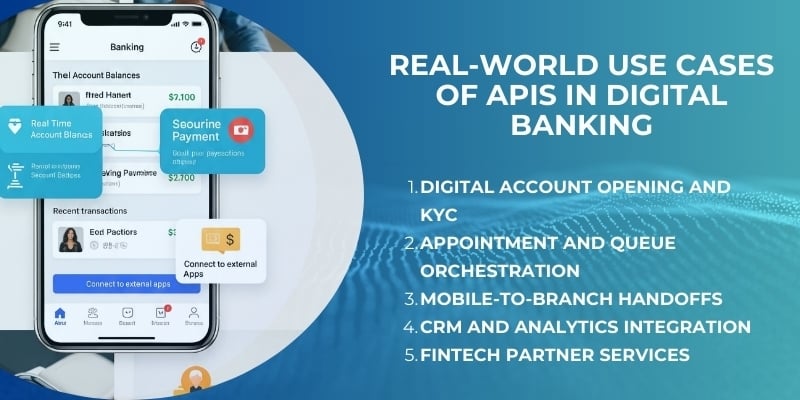
The theoretical value of APIs translates into concrete, measurable business outcomes through specific use cases.
- Digital account opening and KYC: APIs connect the bank’s online application form with identity verification services, credit bureaus, and core account origination systems. A customer can open an account in minutes, not days.
- Appointment and queue orchestration: APIs link scheduling tools, branch queue systems, and staff calendars. Customers can book appointments online and be recognized instantly upon arrival.
- Mobile-to-branch handoffs: A customer starts a loan application on mobile but wants to finalize in person. APIs preserve the application state and notify the branch, enabling a seamless transition.
- CRM and analytics integration: Customer interaction data from digital channels is fed via APIs into the bank’s central CRM, creating a single, complete view of each customer relationship.
- Fintech partner services: Through open banking APIs, customers can authorize third-party apps to access their account data or initiate payments, all within a secure, consent-based framework.
These API-driven banking use cases demonstrate that APIs are not an abstract IT project. They are directly enabling better customer experiences, operational efficiencies, and new revenue models for banking institutions.
Challenges in Banking API Implementation (And How to Overcome Them)
Implementing an API strategy in a large, established bank is not without obstacles.
The most significant banking API challenges include integrating with deeply embedded legacy systems that were never designed for real-time access. Data may be scattered across multiple core platforms, each with its own data model and access method.
Security concerns around exposing sensitive financial data to more endpoints must be carefully managed.
Performance bottlenecks can emerge when high-volume digital channels place unexpected load on back-end systems. Organizational silos between lines of business, IT, and compliance can slow progress.
These challenges are real but solvable. An API-first architecture addresses them by creating a dedicated integration layer that abstracts legacy complexity. Incremental modernization, wrapping existing systems rather than replacing them all at once, reduces risk.
Investing in a robust API management platform provides the visibility and control needed for security and performance. Cross-functional governance teams ensure alignment between business strategy and technical execution.
For banks committed to digital transformation, the path forward is clear. A strategic approach to digital banking modernization recognizes these challenges and systematically overcomes them.
Future of APIs in Digital Banking
The next evolution of digital banking APIs is already taking shape. Banking-as-a-Service, or BaaS, allows non-bank companies to embed financial products directly into their own customer experiences.
A retailer can offer branded credit, a ride-hailing app can provide driver wallets, and a software platform can integrate invoice financing. All of this is powered by APIs that expose the bank’s licensed capabilities to external partners.
Embedded finance extends this concept further, making financial services invisible and contextual. An AI-powered API might analyze a customer’s cash flow and proactively offer a short-term credit line at the exact moment it is needed.
Hyper-personalized journeys, driven by real-time data and machine learning models exposed via APIs, will become the standard.
The trajectory is clear. Accenture predicts that over 70 percent of banks will offer API-based embedded finance capabilities by the end of the decade. The future of digital banking APIs is a future where banking is no longer a place you go, but something you do seamlessly within the flow of life.
FAQs
1. What is the role of APIs in digital banking?
APIs (Application Programming Interfaces) act as secure connectors between core banking systems, digital channels, and third-party platforms. The role of APIs in digital banking is to enable real-time data exchange, automate workflows, and ensure seamless integration across mobile apps, websites, branches, and fintech ecosystems. They allow banks to modernize legacy systems without replacing them entirely.
2. How do APIs improve customer experience in banking?
APIs improve customer experience by enabling omnichannel banking, real-time updates, and personalized services. For example, when a customer starts a loan application on mobile and completes it in a branch, APIs synchronize the data across systems. They also power instant balance updates, payment confirmations, and personalized offers, reducing friction and service delays.
3. Why are APIs important for open banking?
APIs are the foundation of open banking because they allow secure, consent-based data sharing between banks and third-party providers. Through open banking APIs, customers can connect their accounts to budgeting apps, lending platforms, or investment services. APIs ensure strong authentication, data encryption, and regulatory compliance while expanding banks’ ecosystem partnerships.
4. How do APIs help modernize legacy banking systems?
Many banks rely on legacy core systems that were not designed for real-time digital engagement. APIs modernize these systems by acting as an integration layer that translates digital requests into formats legacy systems understand. This approach reduces the need for full core replacements, lowers risk, and accelerates digital product innovation.
5. Are APIs secure for banking transactions?
Yes, when properly implemented, APIs enhance banking security. Secure API gateways enforce authentication, encryption, authorization controls, and rate limiting. They also create detailed audit trails for compliance with regulations like PSD2 and PCI DSS. In many cases, API-based frameworks reduce fraud risk by replacing outdated point-to-point integrations with centrally governed, monitored interfaces.
Conclusion
The role of APIs in digital banking is foundational. They are the connective tissue that links legacy core systems to modern digital channels.
- They enable the real-time data exchange, automation, and seamless orchestration that customers now expect.
- They power omnichannel consistency across mobile, web, branch, and self-service.
- They open the door to open banking, fintech collaboration, and embedded finance.
- They strengthen security and streamline compliance.
For banks undertaking the complex work of modernizing their branch networks, self-service capabilities, and overall customer journeys, an API-first strategy is not an optional technical detail. It is the essential architectural principle upon which a competitive, scalable, and future-ready bank is built.
Investing in a comprehensive digital banking APIs strategy is investing in the bank’s ability to compete and grow in an increasingly connected financial ecosystem.
BOOK A FREE DEMO