How Digicel Modernized Self-Service Infrastructure Across Five Caribbean Markets with Wavetec’s Cloud-Native Kiosk and API Orchestration Platform
Executive Summary
Digicel, a major telecommunications and digital services provider operating in 25+ markets across the Caribbean, Central America, and the Pacific Islands, partnered with Wavetec to replace a fragmented legacy self-service infrastructure with a fully automated, cloud-enabled kiosk ecosystem across five Caribbean markets. The platform supports end-to-end customer journeys, including bill payments, local and cross-border top-ups, prepaid SIM vending, and ePIN wallet recharge through a single unified architecture. By transitioning to an API-driven, middleware-orchestrated model built on Wavetec’s Smart Connect layer, Digicel decoupled its customer-facing service delivery from backend complexity, enabling consistent cross-market scalability, centralized operational control, and the ability to launch new services without hardware changes.
“Replacing fragmented legacy systems with a centralized, cloud-native, and API-driven ecosystem was a foundational shift. It has empowered us to scale our automated customer journeys seamlessly across markets, ensuring speed, security, and a consistently superior experience.”
Naushervan Beg
Head of Global Sales and Strategy – Self Service & Retail Automation at Wavetec
Client Profile
| Industry | Telecommunications |
| Region | Caribbean (Jamaica, Barbados, Trinidad, and additional markets) |
| Organization | Digicel Telecommunications |
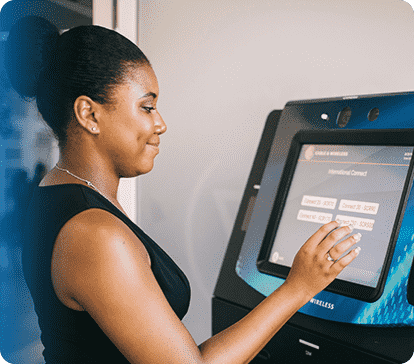
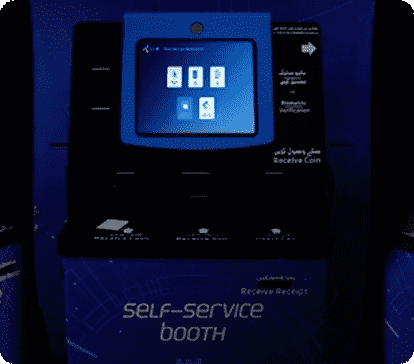
| Channels | Self-service kiosks at in-store and off-site locations |
| Core Use Cases | Bill payments, top-ups, plan purchases, cash deposits, SIM vending, ePIN recharge |
The Challenge
Digicel operates one of the largest telecommunications networks across the Caribbean, serving millions of subscribers across markets with distinct regulatory, taxation, and service requirements. The existing kiosk infrastructure was built for single-market, limited-use deployments with hardware, software, and backend systems tightly coupled, making any service enhancement dependent on physical intervention and market-by-market reconfiguration.
Fragmentation across legacy and modern backend systems made it impossible to deliver a consistent customer experience or maintain centralized visibility into transaction performance. Cross-border service requirements including international top-ups, variable tax logic, and multi-currency exchange rate management added further complexity that the existing architecture could not accommodate without significant manual effort per market.
Why the Previous Model Did Not Scale
| Legacy Constraint | Operational Impact |
| Earlier-generation platforms designed for single-market use cases | Restricted ability to introduce new services and scale across multiple markets |
| Tight coupling between hardware, software, and backend systems | Slower rollout of enhancements and increased dependency on physical upgrades |
| Fragmented system landscape mixing legacy and modern platforms | Inability to deliver a unified customer experience or centralized reporting |
| Limited configurability for market-specific requirements | Increased operational effort to adapt tax logic, exchange rates, and cross-border rules per market |
Solution Overview
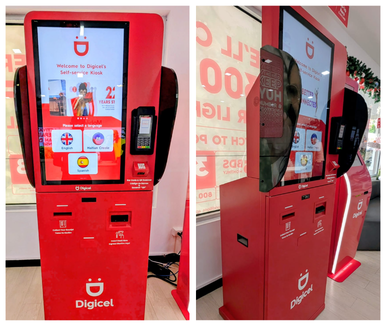
Wavetec implemented a cloud-enabled, API-driven self-service kiosk platform centered on the Smart Connect middleware orchestration layer. The solution decoupled the kiosk channel from Digicel’s backend systems, placing all business logic including MSISDN validation, eligibility checks, tax calculations, and cross-border rules into a centralized layer communicating with both legacy and modern backend infrastructure simultaneously.
New services can be configured once and deployed across all markets without hardware changes or market-specific reconfiguration, enabling a write-once, deploy-anywhere operational model with full centralized monitoring and unified reporting.
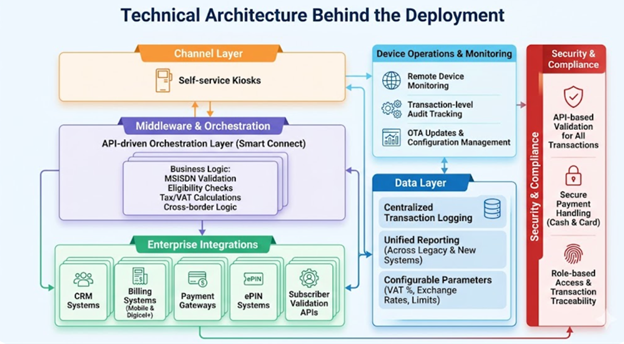
Technical Architecture Behind the Deployment
Channel Layer
- Self-service kiosks deployed across in-store and off-site locations in all five markets
Middleware and Orchestration
- Smart Connect API orchestration layer acting as the abstraction boundary between kiosks and all backend enterprise systems
- Centralized business logic handling MSISDN validation, eligibility checks, real-time VAT calculations, and cross-border transaction rules
- Error handling and graceful degradation maintaining transaction continuity under backend latency or downtime
- Configurable parameters for VAT percentages, exchange rates, top-up limits, and cross-border market selection per market
Enterprise Integrations
- CRM, billing system (mobile and Digicel+), payment gateway, and ePIN system integration via secure APIs
- Subscriber validation APIs for real-time MSISDN lookup, balance retrieval, and plan provisioning
- Parallel integration architecture supporting simultaneous legacy and modern backend communication
Data Layer and Device Operations
- Centralized transaction logging with unified reporting across all markets and system types
- Remote device monitoring, transaction-level audit tracking, and over-the-air configuration management
- Role-based access control and full transaction traceability across cash and card payment channels
Security and Compliance
- API-based validation for all transactions
- Secure payment handling (cash & card)
- Role-based access and transaction traceability
Architectural Perspective: From Legacy Silos to API-First Orchestration
The transition Digicel undertook was not a hardware refresh. It was a foundational architectural shift away from monolithic, device-level business logic toward a middleware-first model where rules are maintained centrally and pushed across all markets simultaneously.
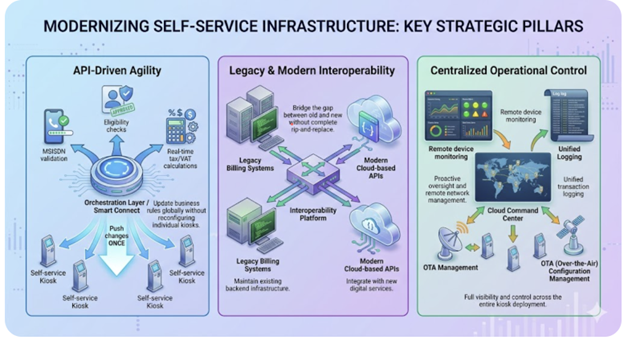
Architectural Strategy: Decoupling and Orchestration
- The core of our success lies in the transition to a middleware-first approach. By implementing Smart Connect, we created an abstraction layer that effectively separates the “Channel Layer” (the kiosk hardware) from our complex backend enterprise systems.
- API-Driven Agility: We shifted business logic—such as MSISDN validation, eligibility checks, and real-time tax/VAT calculations—into the centralized orchestration layer. This ensures that when we update business rules, we push changes once, rather than reconfiguring individual kiosks.
- Legacy & Modern Interoperability: A major engineering milestone was the platform’s ability to communicate simultaneously with legacy billing systems and modern cloud-based APIs. This allowed us to modernize the customer journey without waiting for a complete rip-and-replace of our backend infrastructure.
- Centralized Operational Control: We moved from reactive, localized maintenance to proactive, cloud-based oversight. With unified transaction logging, remote monitoring, and OTA (Over-the-Air) configuration management, we now have full visibility into the health and performance of our kiosk network across multiple regions.
Customer Journeys Enabled
- Instant bill payment for mobile and Digicel+ broadband accounts with real-time balance retrieval and tax logic applied automatically
- Local and cross-border top-ups with dynamic exchange rate application and carrier backend routing managed by the Smart Connect layer
- Prepaid plan purchase with real-time eligibility validation and immediate provisioning upon payment confirmation
- Prepaid SIM vending with QR-based activation enabling full self-onboarding without staff intervention
- Cash deposits into Digicel accounts and ePIN wallet recharge for agents, both fully automated with real-time balance confirmation
Results
The deployment delivered measurable improvements across service availability, operational efficiency, and cross-market scalability.
| KPI | Before | After | Change |
| Service Availability | Limited by legacy constraints | Always-on automated kiosks | Significant improvement |
| Time to Launch New Services | Slow, manual per-market reconfiguration | Rapid via centralized platform | Faster rollout across all markets |
| Customer Experience | Fragmented across markets | Unified, guided journeys | Strong consistency improvement |
| Cross-Market Capability | Not scalable beyond single-market | Fully enabled across 5 markets | Major capability enhancement |
| Operational Visibility | Limited, localized per market | Centralized unified reporting | High transparency across network |
| Backend Flexibility | Dependent on single architecture | Legacy and modern system support | Significant architectural improvement |
Business Impact
Unified Cross-Market Service Delivery
Five markets now operate from a single deployment model. Configurations and updates are managed centrally and propagated simultaneously, eliminating per-market integration overhead.
Legacy and Modern System Interoperability
The platform communicates with legacy billing systems and modern cloud APIs in parallel, allowing Digicel to modernize the customer experience without waiting for a full backend replacement.
Write-Once, Deploy-Anywhere Scalability
New services are configured once and deployed across all markets without hardware changes, reducing the cost and time associated with service launches significantly.
Centralized Operational Transparency
Transaction auditing, cash and card flow monitoring, and device health tracking are consolidated into a single operational view, eliminating data silos across markets.
Business Continuity Through Resilient Architecture
The decoupled architecture ensures backend latency or downtime does not surface to the customer-facing kiosk layer. The Smart Connect layer handles failures gracefully, maintaining transaction flow continuity.
Why This Deployment Scaled
The API-first design ensured every service journey passed through a single orchestration layer, removing the need for individual market teams to manage service configurations independently. The middleware abstraction between the kiosk channel and backend systems made the platform backend-agnostic, allowing Digicel to integrate new systems or modify business rules without any impact on the customer-facing experience.
Cloud-based deployment enabled centralized control that on-premise architectures cannot match. The configurable parameter framework for VAT, exchange rates, and cross-border logic allowed market-specific regulatory compliance to be handled through data configuration rather than code changes, making regional adaptation operationally straightforward at scale.
Frequently Asked Questions
Can the platform support multiple backend systems simultaneously?
Yes. Smart Connect integrates with both legacy and modern backend systems in parallel, allowing operators to modernize customer journeys without replacing existing infrastructure.
How are cross-border transactions managed?
Market selection, exchange rate application, and tax calculations are handled dynamically within the Smart Connect layer using centrally managed configurable parameters, with no manual intervention or device-level reconfiguration required.
How are new services launched across markets?
Services are configured once at the platform level and deployed across all markets simultaneously via the cloud management layer. No hardware changes are required.
How does the platform handle backend downtime?
The orchestration layer manages failure states gracefully without surfacing them to the end customer, maintaining transaction flow continuity under degraded backend conditions where technically possible.
About Wavetec’s Telecommunications Solutions
Wavetec provides enterprise-grade self-service kiosk platforms, queue management systems, and customer experience solutions for telecommunications operators across emerging and developed markets. The platform enables API-driven service orchestration, cross-market deployment at scale, and centralized operational management, helping telecom operators including Digicel, Rakuten, Telcel, Vodacom and others, and other multi-market carriers transform self-service infrastructure into automated, always-on customer touchpoints.
Ready to Transform Your Customer Experience Operations?
Whether you manage a telecom, real estate service center, government office, financial branch, or high-volume customer service environment, Wavetec’s integrated queue management and customer experience solutions help you serve customers faster, smarter, and more consistently.